
Most owners review their prices far too rarely — often only when something forces them to, which can be years apart. It feels prudent and customer-friendly. It’s quietly one of the most expensive habits in small business.
Here’s why. Your costs don’t rise in a single, announceable jump; they creep. Materials, wages, energy, software, insurance, transport — each edges up a little, month by month, and none of it makes a noise. If your prices only move every two years, you spend those two years absorbing every one of those increases yourself. Your margin narrows the whole time, and because it happens slowly, you often don’t notice until it’s uncomfortably thin.
Reviewing every six months changes the maths. You catch cost creep while it’s small, and you adjust in small steps — a few percent — that customers barely register. Compare that with the two-year approach, where you eventually have to make one large, jarring correction to recover all the ground you’ve lost. Small and frequent is easier to justify, easier to communicate, and far less likely to lose you customers than rare and large.
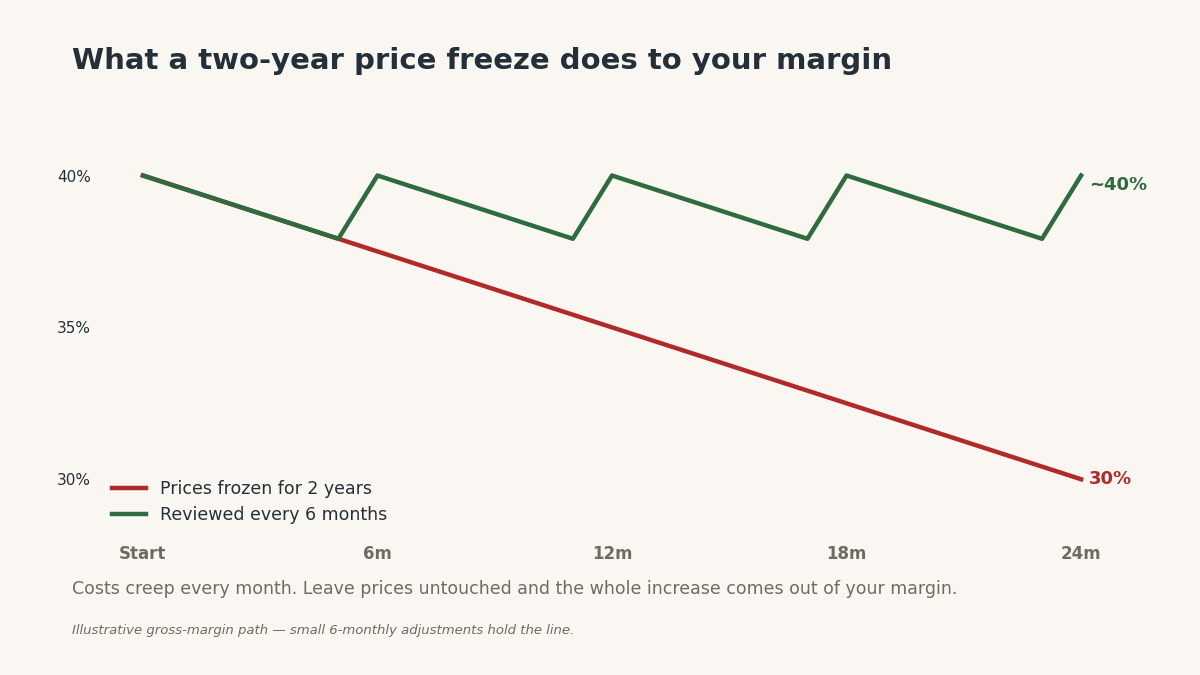
A six-monthly review doesn’t mean a six-monthly increase. Sometimes you’ll hold, sometimes nudge, occasionally cut a line that’s uncompetitive. The point isn’t to raise prices on a timer — it’s to look on a timer, so pricing is a decision you make with open eyes rather than one made for you by inflation.
The trade-off is effort and nerve: reviewing prices means confronting the awkward question of whether to charge more, twice as often. Many owners avoid it precisely to dodge that discomfort — and pay for the avoidance in eroded margin.