
Know your numbers
Read Your Profit & Loss in 10 Minutes: The One Report You've Been Ignoring

Every month, your accountant sends you a profit and loss statement. Maybe it lands in your inbox. Maybe it's a tab in some software you log into twice a year. Either way, be honest — you probably glance at one number, the one at the very bottom, and close it again.
You're not alone. Around a third of owners say they often don't even know whether they made a profit last month. And here's the part nobody admits: plenty of us are too embarrassed to ask what the rest of the page means, because we feel like we should already know.
So let's fix that. Not with a lecture on accounting. Just a plain-English walk down the page, top to bottom, so the next time that report lands you can read it like a map instead of a foreign language.
Because that's all a profit and loss statement really is — a map of where your money came from and where it went, over a month or a year. Read it properly and it tells you exactly which part of your business is working and which part is quietly bleeding.
Start at the top, not the bottom
Most owners read a P&L backwards. They jump to the last line — the profit — panic or relax, and stop there. But the story is in the order the page is laid out. Read it top to bottom and every number explains the one below it.
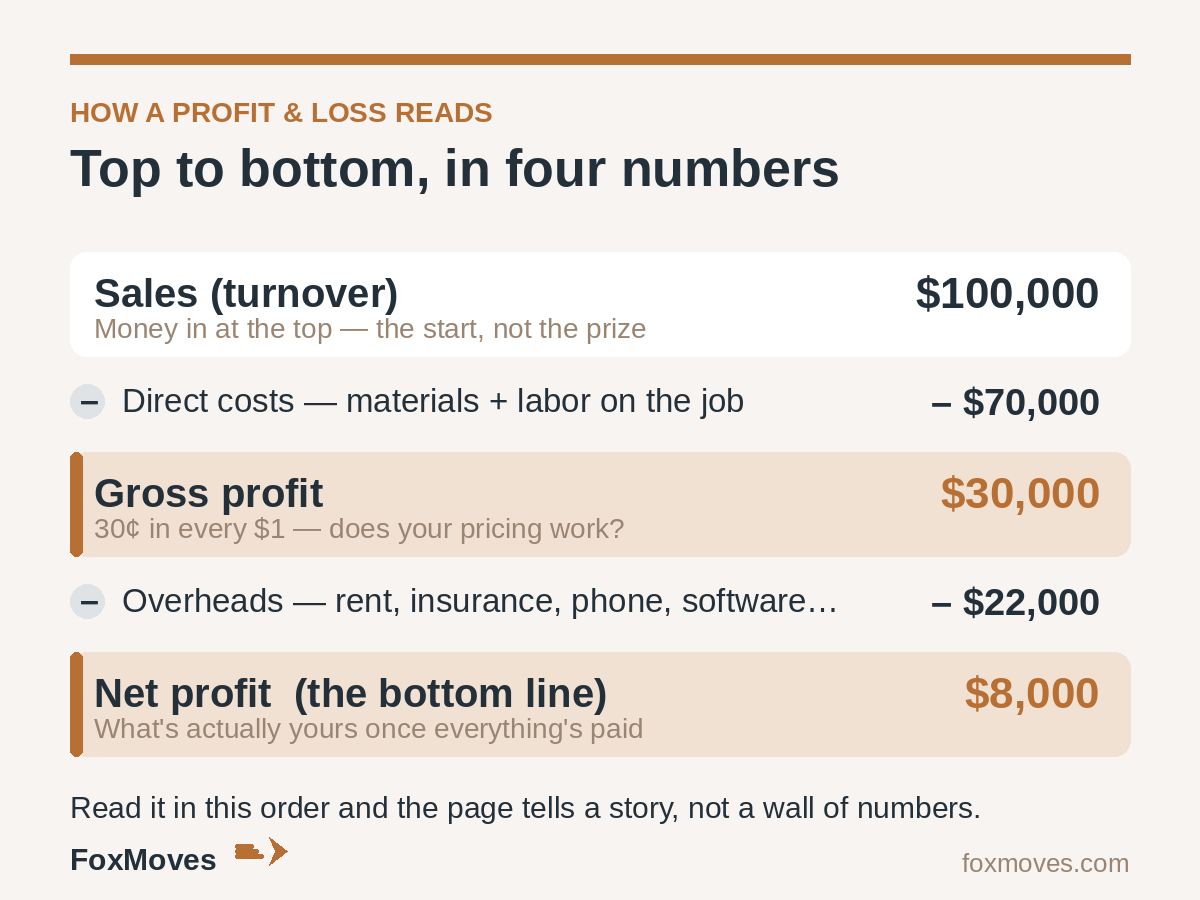
There are really only four things on the page that matter. Learn these four and you've read your P&L.
1. The top line — your sales (turnover)
The very first number is your total sales for the period. Money in from doing what you do. This is your turnover — also called revenue.
This is the number owners love to quote at the pub. "We turned over half a million this year." But turnover is not money you get to keep. It's just the starting point. A big top line with everything below it eating away tells you nothing about whether you're actually making a living.
So note it, but don't celebrate it yet. We're four lines from the truth.
2. Cost of what you sold — the direct costs
The next chunk is the cost of the stuff that goes directly into your sales. The materials. The parts. The wages of the people doing the actual work. The subcontractor you paid to help finish the job.
The rule of thumb: if you didn't win the job, you wouldn't spend this money. No sale, no cost. That's a direct cost.
Take these away from your sales and you get the most useful number on the whole page — and almost nobody looks at it.
3. Gross profit — the number that tells you if your pricing works
Sales minus your direct costs equals your gross profit. This is what's left after you've paid for the actual work, but before the rent, the phone, the accountant, and everything else it takes to keep the doors open.
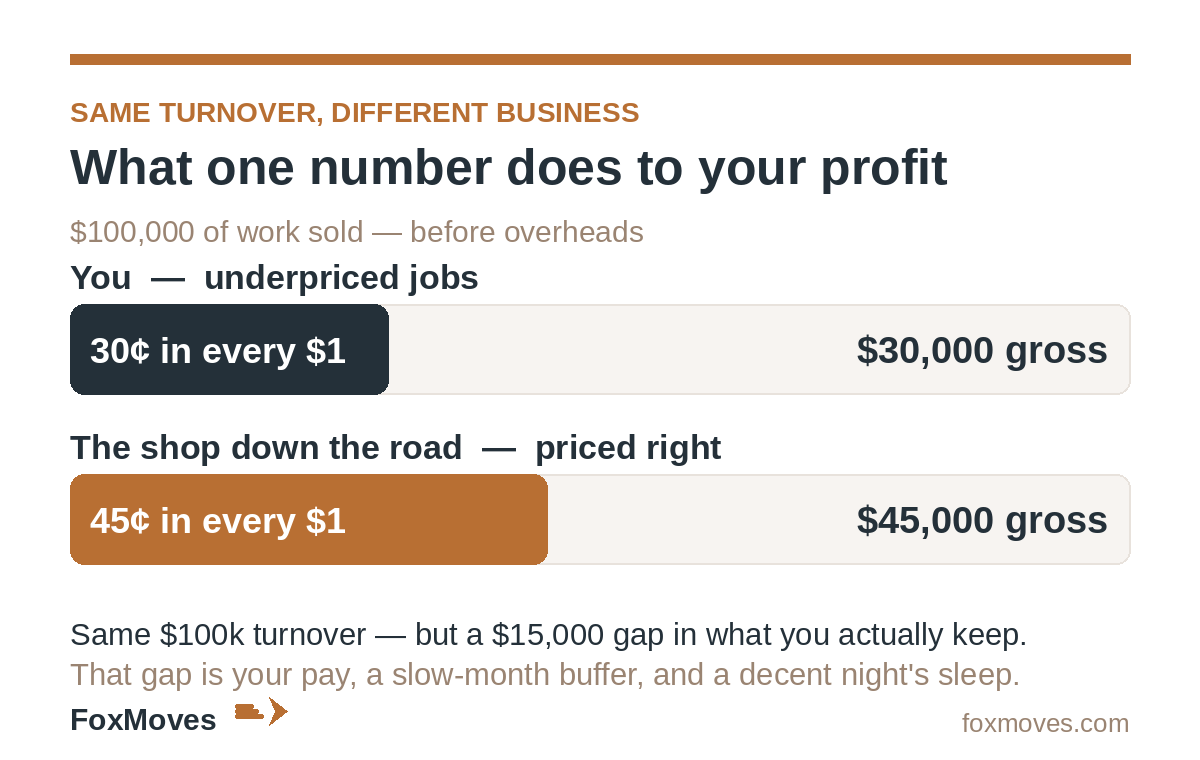
This one number tells you whether you're charging enough. If you sold $100,000 of work and it cost you $70,000 in materials and labor to deliver it, your gross profit is $30,000 — and your margin is 30 cents in every dollar. If a competitor down the road runs the same trade at 45 cents in the dollar, they can pay themselves more, weather a slow month, and still sleep at night. You can't. Same turnover, very different business.
4. Overheads — the cost of keeping the lights on
Below gross profit sits the long list of everything else. Rent. Insurance. Your phone and internet. Software. The accountant. Office wages. Vehicle costs. Bank fees. These are your overheads — the costs you'd still have to pay next month even if you didn't win a single new job.
This is the list to scan when you want to find quick wins, because a lot of it creeps up on you — a subscription here, a renewal there — and no single line looks big enough to bother with. Added up, they decide whether your gross profit survives to become take-home profit.
The bottom line — what's actually yours
Gross profit minus overheads equals your net profit. The bottom line. What the business actually made once everything is paid for.
Now you can read the whole story in one pass:
- Sales came in at the top.
- Direct costs took their cut, leaving gross profit — your pricing verdict.
- Overheads took their cut, leaving net profit — what you actually keep.
Do that once and you'll never see the page as a wall of numbers again. You'll see four levers. And you'll know which one to pull.
Read it as a story, not a snapshot
One month's P&L is a photo. The real value is in the film — reading this month next to last month, and this month next to the same month last year.
A single figure means very little. "We made $8,000 net profit" — good or bad? You can't tell. But "$8,000 this month against $14,000 the same month last year, on higher sales" — that's a flashing light. Your top line grew and your bottom line shrank. Something in the middle is eating the difference, and now you know to go find it. The P&L just did its job.
You don't need to become an accountant. You need to be able to open the report your accountant already sends you and know what you're looking at. Ten minutes, four numbers, top to bottom.
Do this next
This week, dig out last month's profit and loss statement — from your inbox, your software, or a quick email to your accountant. Then do one thing: find your gross profit. Sales, minus the direct cost of doing the work. Write down the margin — how many cents in every dollar you keep before overheads.
That one number will tell you more about the health of your business than the turnover you've been quoting all year.